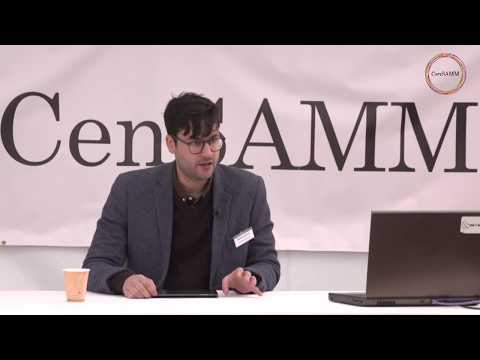
Michael Morelli: Representing the End—The Ethical Implications of Praying to Bots
Michael Morelli
33.34
11 April 2018
17 December 2025
Michael Morelli, doctoral candidate studying theological ethics at University of Aberdeen.
"Representing the End—The Ethical Implications of Praying to Bots."
Although full fledged artificial intelligence technologies currently remain in research and development phases there already have been modest advances in AI. Chatbots are an example. The New York Times reports:
For celebrities who already use Twitter, Instagram, and Snapchat to lend a personal touch to their interactions with fans, the next frontier of social media is a deliberately impersonal one: chatbots, a low-level form of artificial intelligence that can be harnessed to send news updates, push promotional content, and even test new material.
Fan engagement with such bots has become substantial enough to spark interest, investment, and research from a variety of individuals and groups. Even if fans are aware that bots are not human and the celebrity being represented is not present, there is enough of a sense of connection to keep fans engaged. This is because fans interact with the bot as if the bot is the individual being imitated.
One way to view these interactions is to read them as basic pop culture phenomena: fans desiring to connect with a celebrity. Another way to view these interactions is to read them as religious phenomena: individuals praying to their respective god or gods. The frequent crossover between pop culture and religious language is revealing in this respect. Fans worship pop stars who are often referred to as gods, and as a part of that worship, pray to their god(s) in order to satisfy existential desires for connection. Even if what—or whom—is prayed to is a bot.
Thinking of AI chatbots from this perspective reveals an implicit religious narrative in the fundamental architecture of chatbot AI technologies. In fact, there also exist chatbots designed explicitly for prayer. With such developments in AI technology in view, this paper examines the religious narratives present in these AI technologies and considers their ethical implications. Then, it builds upon this examination with a consideration of the implicit and explicit religious connection between prayer and understandings of the apocalypse.
As sociologist-theologian Jacques Ellul argues in Prayer and Modern Man, “Prayer is the ultimate act of hope, otherwise it has no substance. Because it is an act of hope, every prayer is necessarily eschatological [and apocalyptic].” If prayer is a hopeful look to the future and a potentially apocalyptic end, what sort of future and apocalyptic end might be represented by prayer and chatbots?
AI and Apocalypse conference
April 4 2018