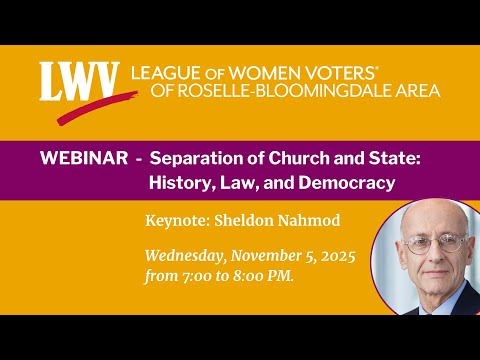
Separation of Church and State: History, Law, and Democracy
Vincent Bacote
71.16
17 November 2025
22 November 2025
The separation of church and state—a cornerstone of American democracy is now at the center of national debate.
Our keynote speaker, Sheldon Nahmod, Distinguished Professor of Law Emeritus at Chicago-Kent College of Law, a nationally recognized expert in constitutional law, provided historical context on the Founding Fathers’ differing views, key constitutional provisions, and today’s political interpretations of church-state separation.
Following his presentation, panelists from three faith-based organizations shared how their work addresses issues of religious freedom, democracy, and bridging divides. Our panelists were:
Dr. Vincent Bacote, Director of the Center for Applied Christian Ethics at Wheaton College,
Chris Crawford, Senior Director of Civic Strategies at Interfaith America, and
Terry Kyllo, Lutheran Pastor and Executive Director of Paths to Understanding.
Summary: The First Amendment protects both religion from government and government from religion. The Establishment Clause keeps the government from promoting religion, while the Free Exercise Clause protects people’s religious practices.
The Framers had different approaches. Some, like Jefferson and Madison, wanted a strict separation — a “wall” between church and state. Others, like Washington and Adams, favored accommodation, letting government support religion in limited ways. Modern law also emphasizes neutrality — the government shouldn’t favor one religion over another, though it can sometimes favor religion over non-religion.
On the Establishment Clause side, courts have ruled that school prayer is banned, but legislative prayer is allowed. Government can fund secular parts of religious schools, and vouchers are OK if parents choose. Religious displays, like a nativity scene, are often allowed if mixed with secular elements.
The Free Exercise Clause protects people from laws that burden their religion. After 1990’s Employment Division v. Smith, neutral laws didn’t require exemptions. But recent cases show the Court is giving stronger protection: religious groups must get equal treatment and may even be included in government funding programs.
In short, over the last 20 years, the Establishment Clause has narrowed, giving government more leeway, while the Free Exercise Clause has strengthened, expanding protections for religious practice. With today’s Supreme Court, this trend is expected to continue.