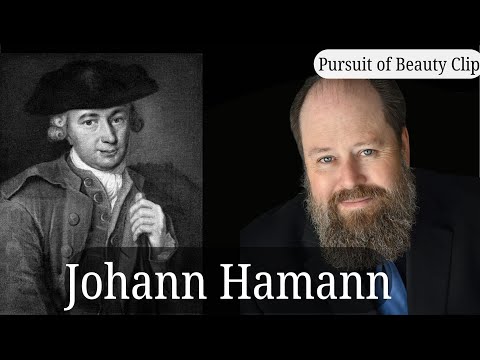
David Bentley Hart: The Critique That DESTROYED Kant (and Analytic Philosophy)
David Bentley Hart
9.53
1 December 2025
6 December 2025
Watch the full video here! https://youtu.be/3D9BSPMF9ec?si=T5ZrpCllFoOW6CKQ
David Bentley Hart explores one of philosophy's most devastating critiques—Johann Georg Hamann's assault on Kant's pure reason—in this illuminating conversation with Matthew Wilkinson. Hart calls Hamann's "Metacritique of the Purism of Reason" brilliant, explaining how this eccentric Christian mystic anticipated postmodern philosophy by two centuries and exposed fundamental flaws in both Kantian and analytic philosophy that persist today. This discussion reveals why Hart considers Hamann essential for understanding the relationship between language, reason, and divine revelation, while also exploring how radically different philosophical traditions—from biblical theology to Neoplatonism—might ultimately coincide in truth.
The conversation begins with the remarkable story of how Hamann literally "kidnapped" the first version of Kant's Critique of Pure Reason from the press before publication to write his counter-critique. Despite being friends (Kant had "the highest esteem" for Hamann and helped support him financially), Hamann launched an attack so powerful that even Hegel felt compelled to address it. Hart explains how Hamann's critique historicized language and reason, destroying the pretense that words and ideas exist as timeless categories with fixed meanings. This insight, Hart argues, demolishes "nine tenths of analytic philosophy" which still makes Kant's mistake of treating propositions as abstract syntax that can be mapped across cultures and centuries without change.
Hart illustrates this problem with a brilliant anecdote about a student who criticized Aristotle's "confused" understanding of causality, not realizing that Aristotle never wrote about "causality" at all—he wrote about "aitia" (αἰτία), which has completely different meanings from our modern concept of energetic force exchange. This exemplifies Hamann's point: reason is always embodied in particular languages, cultures, and histories. You cannot abstract pure logical relations from their linguistic contexts. Analytic philosophy's attempt to reduce everything to syntactical relations like "X, Y, Y2, YPH" fundamentally misunderstands how human thought actually works. Hamann saw this clearly in 1784; many philosophers still haven't caught up.
The discussion then ventures into surprising theological territory when Wilkinson asks whether Hamann's radically embodied, historical understanding of reason can be reconciled with Neoplatonic metaphysics. Hart affirms this as one of two primary routes for doubters: "I can give you the Pseudo-Dionysius or I can give you Hamann." Despite their apparent opposition—Hamann famously declared "I couldn't worship a god without genitals" and put a satyr's head on a book cover to shock Lutheran piety—Hart argues these approaches ultimately coincide. As a "good Cusan" (follower of Nicholas of Cusa), Hart believes God is the coincidence of opposites. Hamann's biblical God who is "poet at the beginning of days and critic at the end" doesn't contradict the Neoplatonic One; rather, our failure to see their unity reflects a "lack of imagination on our part."
Hart's synthesis is profound: if God is "the fullness of all being," then He must be "the full actuality of such things as love and creativity and the arts." What Neoplatonic "apatheia" (divine impassibility) excludes isn't the reality of emotion or creativity, but only "pathos"—passive suffering that would change God. The actuality of love, personality, and artistry exists in "super eminent reality" in the divine. Hart reminds us that even Plotinus describes the heavenly realm as filled with "infinite numbers of spirits with shining faces"—it's a community, not an escape from personality. We misread both traditions: Neoplatonism isn't really about fleeing embodiment, and Hamann doesn't really believe in an anthropomorphic deity. The reconciliation occurs not just at the logical level but requires imaginative work to see how these "different modalities of understanding and discourse" complement each other and "ultimately coincide in the truth."
Key philosophers discussed: Johann Georg Hamann, Immanuel Kant, G.W.F. Hegel, Arthur Schopenhauer, Aristotle, Plotinus, Pseudo-Dionysius, Nicholas of Cusa (Cusanus)
Timestamps:
00:00 - Hamann's brilliant critique of Kant
00:17 - The friendship between Kant and Hamann
00:34 - Hamann's influence on Hegel
01:24 - Why Hamann's critique still destroys analytic philosophy
02:40 - The Aristotle anecdote: "He didn't write in English!"
04:50 - Can Hamann be reconciled with Neoplatonism?
05:02 - "Two routes for doubters: Dionysius or Hamann"
06:30 - "I couldn't worship a god without genitals" - Hamann's shock tactics
07:30 - God as coincidence of opposites
08:54 - How Hamann anticipated postmodern critiques
#DavidBentleyHart #Hamann #Kant