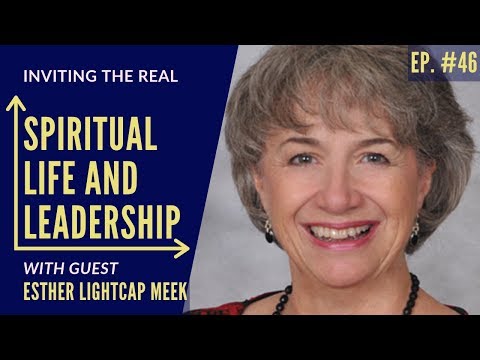
Does faith require us to abandon reason? - Esther Lightcap Meek
Esther Meek
0.58
28 August 2019
21 March 2026
This clip is from Episode 46, "Inviting the Real, with Esther Lightcap Meek," on the Spiritual Life and Leadership podcast. Click here for the full episode: https://markuswatson.com/2019/08/05/inviting-the-real-with-esther-lightcap-meek-author-of-a-little-manual-for-knowing-046/
Click here for the podcast: https://markuswatson.com/category/podcast/
In her book, A Little Manual for Knowing, Esther Lightcap Meek says that in order to truly know something, we must welcome “the yet-to-be-known with respect, humility, patience, and attentiveness.” In fact, radical attentiveness, says Meek, is essential to true knowing.
In this episode of Spiritual Life and Leadership, Esther Lightcap Meek, unpacks what she calls “covenant epistemology,” an approach to knowing that acknowledges the relationship between the knower and the known. This all sounds very academic, but it’s an approach that I believe can help us better life into the way God is calling us–actually calling us–to bring healing to the world.
THIS EPISODE’S HIGHLIGHTS INCLUDE:
-
Esther Lightcap Meek is the author of A Little Manual for Knowing and Professor of Philosophy at Geneva College in Beaver Falls, Pennsylvania.
-
Epistemology is the study of knowledge.
-
Esther grew up “a good little Christian girl.” In eighth grade, she began to question her faith, including, “How do I know there is a world outside my mind?”
-
Esther read The God Who is There by Francis Schaeffer when she was in high school. It was then that her questions were not sin, they were philosophical.
-
When we make contact with reality, it’s like reality contacts us back.
-
There is an unfolding relationship between the “yet-to-be-knower” and the “yet-to-be-known.”
-
The dominant paradigm for thinking about knowledge is that knowledge is nothing more than information to be acquired.
-
Subsidiary Focal Integration is a way of describing the fact that knowing relies on a multitude of “subsidiary” knowings. In riding a bicycle, we focus on where we are going. Subsidiary to that focus is the knowledge of balance, pedaling, braking, steering, and so forth. When we know something we are integrating into our focus all the subsidiary patterns that make up that knowledge.
-
When we focus on the Bible as information to be gathered, we end up blocking reality.
-
When we talk to our neighbors about Jesus, Esther suggests that to our neighbor it often feels like we’re asking them to check their brain at the door.
-
When we memorize scripture, it’s not so that we can merely have scripture memorized. It is so that we can indwell scripture subsidiarily.
-
We are called to a generosity of attention. When we pay attention—truly pay attention—we invite the real.
-
You can find out more about Esther on her website, http://www.longingtoknow.com/, and on her Facebook page.
RELEVANT RESOURCES AND LINKS
Esther Lightcap Meek
Website: http://www.longingtoknow.com/
Facdbook: https://www.facebook.com/Esther-Lightcap-Meek-110487169038640/
Books mentioned:
A Little Manual for Knowing by Esther Lightcap Meek
Longing to Know by Esther Lightcap Meek
Loving to Know by Esther Lightcap Meek
The God Who is There by Francis Schaeffer
Personal Knowledge by Michael Polanyi
The Catholicity of Reason by D.C. Schindler
No God, No Science: Theology, Cosmology, Biology by Michael Hanby
The Gospel in a Pluralist Society by Lesslie Newbigin
Proper Confidence: Faith, Doubt, and Certainty in Christian Discipleship by Lesslie Newbigin
Western Culture in Gospel Context: Towards the Conversion of the West by David J. Kettle
Video mentioned:
Wonder: The Final Word by D.C. Schindler
To leave a review:
https://podcasts.apple.com/us/podcast/spiritual-life-and-leadership/id1435252632