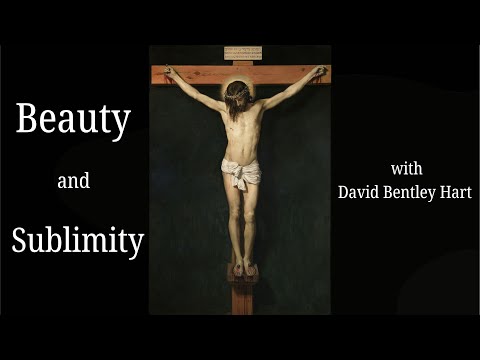
"A Man Nailed to a Cross" - David Bentley Hart on Christianity's Aesthetic Revolution (clip)
David Bentley Hart
12.31
7 November 2025
7 January 2026
Watch the full video here! https://youtu.be/3D9BSPMF9ec?si=T5ZrpCllFoOW6CKQ
David Bentley Hart offers a revolutionary understanding of beauty and sublimity that challenges centuries of aesthetic philosophy in this profound conversation with Matthew Wilkinson. Drawing from Longinus to Kant, from Thomas Aquinas to the Romantics, Hart argues that the traditional dichotomy between the beautiful and the sublime dissolves within Christian thought—and that this dissolution reveals something essential about the nature of divine love itself. This discussion moves from technical philosophy to the very heart of what makes art sacred or profane.
Hart dismantles our post-Romantic assumptions about these categories. The sublime originally meant something quite different from Kant's overwhelming force or Burke's terror. In Longinus, sublimity was "noble plainness"—sub limine, below the threshold—like the unadorned power of Hebrew scripture where ornament would only detract from truth. Meanwhile, beauty in Aquinas (pulchritudo) was simply "what is bright and sparkly and appealing," not yet the transcendental category we imagine today. Hart traces how these concepts evolved through Burke, Kant, and into the Romantic era with Schiller, Schelling, and Beethoven, where the boundaries between beautiful and sublime finally collapsed entirely.
The conversation's most striking insight emerges when Hart explains why Christianity necessarily destroys the beautiful/sublime distinction. "We're confronted with a man nailed to a cross," he observes—the most shameful, humiliating form of execution in the Greco-Roman world, yet Christians see in this broken criminal "the very presence of God." This radical inversion extends to Matthew 25's command to see Christ in "the poor, the hungry, the naked, the stranger, the imprisoned, the migrant at the border." Christian aesthetics must find beauty precisely where the world sees only degradation. Hart argues this sensibility already permeates Western art: Shakespeare's plays mix the comic, tragic, and lyrical in ways "unthinkable in the classical world," while Beethoven's symphonies make any separation of beautiful from sublime impossible.
The discussion ventures into metaphysical territory, exploring whether love itself might be a transcendental convertible with beauty, truth, and goodness. Referencing the Dionysian corpus and Aquinas, Hart argues that if God is love and God is simple and infinite, then all divine names must ultimately converge. But this isn't mere abstraction—Hart insists there's a "phenomenological warrant" for this convergence. We experience it directly: holiness and charity evoke the same response as beauty; the more authentic our love, the more beautiful its object becomes. This leads to Wilkinson's friend Tom's insight that genuine artistic innovation comes not from trying to be novel, but from loving multiple traditions so deeply that innovation occurs naturally—like someone who loves both Greco-Roman and Japanese architecture creating something genuinely new without effort.
The conversation concludes with a damning assessment of contemporary art's lovelessness. Hart distinguishes between art that emerges from "acts of love searching for its proper object" and art where "irony has entirely crowded love out." In our current moment, he observes, "you can make a good living as an artist without any trace of talent" because the artwork has become merely "a fetish that is worth money." This connects back to the opening discussion: when art loses its connection to love, it loses its connection to beauty, and what remains is either empty irony or commodified objects. The solution isn't traditionalism or avant-gardism, but recovering art as an expression of love—which necessarily makes it an expression of the divine beauty that transcends all human categories.
Key thinkers discussed: Longinus, Edmund Burke, Immanuel Kant, Thomas Aquinas, Pseudo-Dionysius, Friedrich Schiller, Friedrich Schelling, G.W.F. Hegel, Jean-Luc Marion, Shakespeare, Beethoven
Theological concepts explored:
- The transcendentals (beauty, truth, goodness, love)
- Christian iconography and the crucifixion
- Matthew 25 and seeing Christ in the marginalized
- The phenomenology of divine beauty
Musical references: Beethoven's 3rd Symphony, 6th Symphony, Grosse Fuge; Messiaen; Penderecki's St. Luke Passion
Timestamps:
00:00 - Should beauty and sublimity be separate categories?
00:23 - The original meaning of sublime: "noble plainness"
01:54 - From Kant's overwhelming sublime to Romantic fusion
03:30 - Beethoven: Where beauty and sublime become inseparable
04:15 - The crucifixion: Christianity's aesthetic revolution
05:30 - Shakespeare's unprecedented mixing of tragic and comic
07:06 - Are love and beauty convertible transcendentals?
09:22 - Love as the source of genuine artistic innovation
11:02 - Why contemporary art lacks love (and therefore beauty)
#DavidBentleyHart #ChristianAesthetics #Philosophy