Forgiveness as a Vital Sign: An evolutionary and theological perspective
Mark Heim
66.38
27 February 2024
30 October 2025
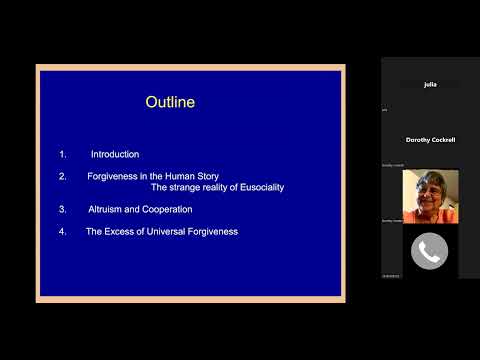
SUMMARY: In modest, routinized forms, forgiveness is a constant feature of our daily lives. In its most extreme instances, forgiveness is extraordinary behavior, testing the limits of what seems humanly possible, wise, or just. The benefits of forgiveness are usually pictured as healing for individual victims and offenders. I suggest the role of forgiveness can be measured also as a function of the health of an entire system, or as a condition for certain kinds of community. In evolutionary perspective, this “vital sign” was integral to the eusocial breakthrough that makes us human. That eusociality seems to have required the explicitly religious formulation of forgiveness. In theological perspective, the “excess” dimension of forgiveness drives not only original hominization but the continuing expansion of our vision of human community.
PRESENTER: S. Mark Heim is the Samuel Abbot Professor of Christian Theology at Andover Newton Seminary at Yale Divinity School. His books include Salvations: Truth and Difference in Religion; Saved from Sacrifice: A Theology of the Cross; Crucified Wisdom: Christ and the Bodhisattva in Theological Reflection, and Monotheism and Forgiveness. He was recently primary investigator on a grant from the American Academy for the Advancement of Science devoted to integrating science into the theological curriculum. With a colleague from the Yale Medical School, Dr. Benjamin Doolittle, he teaches an interdisciplinary course on theology and medicine. An ordained American Baptist minister, his teaching and research interests include comparative theology, theologies of religious pluralism, science and theology, Christology and atonement, and ecumenical ecclesiology.