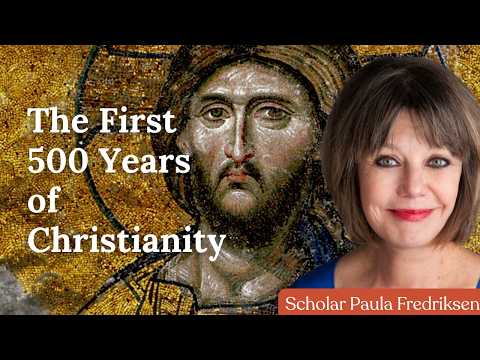
The First Christians: Early Christian Beliefs, Heresies, and the Rise of Orthodoxy —Paula Fredriksen
Paula Fredriksen
48.15
17 November 2025
22 November 2025
Explore the origins of Christianity with historian Paula Fredriksen, author of Ancient Christianities: The First Five Hundred Years (Princeton University Press). In this episode, we examine the diverse early Christian movements, the theology and liturgy of the first Christian communities, and how Christian belief developed across the Mediterranean, North Africa, and the Middle East before the Council of Nicaea.
Fredriksen explains how multiple Christianities—each with distinct ideas about God, Jesus, and salvation—competed long before the Roman Empire made Christianity its official religion. We discuss the emergence of orthodox Christian doctrine, the role of imperial politics, and the suppression of so-called heretical texts and sects.
Key figures include Origen, Valentinus, Justin Martyr, Irenaeus, Athanasius, Tertullian, and Marcion of Sinope, whose debates shaped Christian theology for centuries. This conversation offers a clear, historically grounded look at how early Christianity evolved and why many ancient beliefs disappeared.
If you’re interested in Christian history, biblical studies, early church theology, or the formation of Christian orthodoxy, this discussion provides essential context on the first 500 years of the faith.
[00:00]: Introduction to the podcast focusing on the theology and liturgy of the first Christian communities.
[00:13]: Introduction of Paula Fredriksen, discussing her new book "Ancient Christianities: The First 500 Years."
[01:09]: Discussion about the pressure on early Christian communities to conform to the official version of Christianity.
[02:20]: Heresies in early Christianity and how history was influenced by the dominant theological views.
[07:11]: The development of the concept of heresy and its implications.
[11:47]: Explanation of "late Second Temple Judaism" and its significance.
[15:24]: The relationship between the Septuagint (Greek translation of Jewish scriptures) and early Christian communities.
[17:43]: Discussion on apocalyptic thinking within Jewish and Christian communities.
[21:21]: Charismatic movements within early Christian communities and examples of apocalyptic expectations.
[25:58]: The dominance of Gentile forms of Christianity and their theological implications.
[31:31]: Descriptions of different interpretations of the God of Genesis by early Christians.
[34:44]: Debate over the nature of God in the Old and New Testaments.
[46:27]: Timing of the writing of the Gospels related to the destruction of the temple in 70 AD.
Quillette is an Australian-based online magazine that focuses on long-form analysis and cultural commentary. It is politically non-partisan, but relies on reason, science, and humanism as its guiding values.
Quillette was founded in 2015 by Australian writer Claire Lehmann. It is a platform for free thought and a space for open discussion and debate on a wide range of topics, including politics, culture, science, and technology.
Quillette has gained attention for publishing articles and essays that challenge modern orthodoxy on a variety of topics, including gender and sexuality, race and identity politics, and free speech and censorship.
Quillette's revenue comes from our readers. We are a grassroots organisation that relies on voluntary subscriptions and community membership as our primary revenue stream.
Support Quillette by becoming a subscriber: https://quillette.com/#/portal/signup
Or donate send us a one-off tip: https://quillette.com/#/portal/support
We made our website using Ghost, a powerful app for new-media creators to publish, share, and grow a business around their content. It comes with modern tools to build a website, publish content, send newsletters & offer paid subscriptions to members. Try it here: https://ghost.org/?via=claire91