An Indian Historian Defends the British Empire — And He Has the Data
Nigel Biggar
63.56
27 March 2026
8 April 2026
One of India's leading economic historians challenges the dominant narrative about British rule — from within. Professor Tirthankar Roy on the East India Company, Indian industrialisation, and why the 'extractive empire' myth may be doing more harm than good.
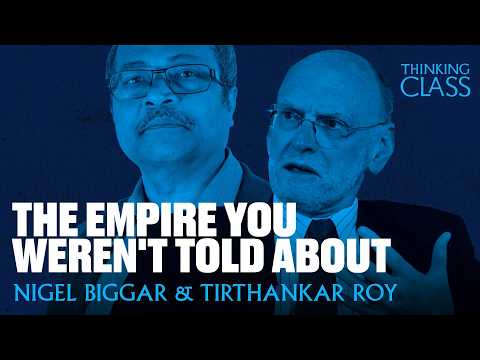
In this episode of Thinking Class, John Gillam is joined by Lord Nigel Biggar and Professor Tirthankar Roy to examine what the British Empire — and the East India Company before it — actually did in India, and how that history continues to shape the present.
Together, they discuss the main charges levelled against British rule in India, including famine, violence, extraction, and the denial of self-government. They also explore why some of those claims may be justified, why others may be overstated, and how both British and Indian historians are rethinking the role of empire, markets, law, trade, migration, and state power.
This conversation goes beyond the usual moral shorthand. It asks how Bombay, Calcutta, and Madras became engines of commerce; how British rule helped create the conditions for law, investment, and global integration; how liberal and constitutional ideas were transmitted; and why India’s rise today makes this history newly relevant.
India is now one of the world’s most important rising powers. Its capital, people, and influence increasingly shape life in Britain and across the West. So the question is not simply what happened in the past — but what we think happened, and how that shapes the future relationship between Britain and India.
In this episode:
- The main charges against the British Empire in India
- Famine, violence, and the question of callousness
- Was British rule really just extractive?
- The East India Company as firm, state, and empire-builder
- Bombay, Calcutta, and Madras as commercial safe havens
- Markets, migration, law, and India’s integration into the world economy
- British liberalism, Indian nationalism, and constitutional development
- How modern India’s rise changes the meaning of this history
Follow Nigel Biggar's work:
- The New Dark Age: https://amzn.to/4kT9NWC
- Lord Biggar’s books: https://amzn.to/4cfUPaZ
- The Biggar Picture: https://www.nigelbiggar.co.uk/
Follow Professor Tirthankar Roy's work:
- Books: https://amzn.to/41tWCCF
About Thinking Class:
Thinking Class is an independent forum for long-form inquiry examining the political, cultural and civilisational questions shaping England, Britain and the West.
Hosted by John Gillam, the show features serious conversations with historians, legal scholars, economists, theologians, politicians, and public intellectuals.
Thinking Class is concerned with discovering long-term patterns over headlines and hot-takes. Expect historically-grounded analysis on matters of national character, institutions, demography, democracy, identity, inheritance, institutional continuity and social change.
New episodes every week.
▶ YouTube: https://www.youtube.com/@ThinkingClass?sub_confirmation=1
🎧 Spotify: https://open.spotify.com/show/37vvzrlxpo8eORDoTDRtbH
✍ Substack: https://thinkingclass.substack.com
🐦 X (Twitter): https://x.com/thinkingclasses
00:00 Introduction — why the British Empire in India still matters today
02:12 The main charges: famine, violence, extraction, and denied self-government
04:41 How historians are rethinking empire — Tirthankar Roy on changing his mind
09:26 The weak state and strong markets: a new framework for understanding British rule
12:49 Where did the "extractive empire" myth come from? State power, socialism, and Indian nationalism
15:45 India's post-independence missteps — Congress, socialist economics, and the flight of capital
18:12 The East India Company and early Indian industrialisation: textiles, steel, and the Tata legacy
20:35 The East India Company as commercial firm, financial innovator, and reluctant state
23:16 What the Company actually did for India: ports, peace, and Indian merchant communities
27:47 Bombay, Calcutta, Madras — safe havens, commercial law, and the draw of the port cities
29:55 Indian attitudes toward British, French, Dutch, and Portuguese: whose rule was preferred and why
36:37 Does India generally take a nuanced view of empire — and are Roy's views unusual?
40:47 Too few historians are speaking up: why the distorted view dominates public discourse
43:01 Famine: were there famines before the British? Addressing the Sussex academic directly
46:37 How the Company became a unified state — and why that matters for modern India's nationhood
50:08 Modern India: economic trajectory, ambitions, and what drives its rise
52:18 Girls' education in India — a transformative force and a compatible space with the West
54:23 The moral case: law, commerce, liberty, and constitutional government as Britain's gifts to India
57:24 What have you changed your mind on? — Tirthankar Roy
58:49 What have you changed your mind on? — Lord Nigel Biggar
1:00:05 Forthcoming books and where to find the guests