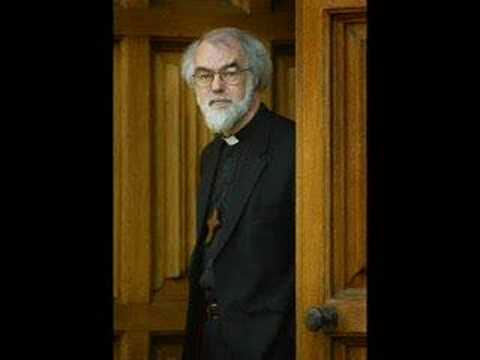
Rowan Williams: The Validity of Religious Law incl. Sharia
Rowan Williams
9.47
10 February 2008
20 August 2025
Bismillah ir-rahmaan ir-raheem The Archbishop of Canterbury is a voice of reason amid a cacophony of bigoted BNP approved hatespeech. Christians should opt-out of the overburdened and radically anti-family British legal system by reinvigorating their canonical courts. As the nation state disintegrates religious pluralism will become more and more acceptable socially and legally in Europe. ---------------- http://www.archbishopofcanterbury.org/1575 ---------------- Archbishop's Lecture - Civil and Religious Law in England: a Religious Perspective Thursday 07 February 2008 The Archbishop of Canterbury, Dr. Rowan Williams gave the foundation lecture at the Royal Courts of Justice The title of this series of lectures signals the existence of what is very widely felt to be a growing challenge in our society -- that is, the presence of communities which, while no less 'law-abiding' than the rest of the population, relate to something other than the British legal system alone. But, as I hope to suggest, the issues that arise around what level of public or legal recognition, if any, might be allowed to the legal provisions of a religious group, are not peculiar to Islam: we might recall that, while the law of the Church of England is the law of the land, its daily operation is in the hands of authorities to whom considerable independence is granted. And beyond the specific issues that arise in relation to the practicalities of recognition or delegation, there are large questions in the background about what we understand by and expect from the law, questions that are more sharply focused than ever in a largely secular social environment. I shall therefore be concentrating on certain issues around Islamic law to begin with, in order to open up some of these wider matters. Among the manifold anxieties that haunt the discussion of the place of Muslims in British society, one of the strongest, reinforced from time to time by the sensational reporting of opinion polls, is that Muslim communities in this country seek the freedom to live under sharia law. And what most people think they know of sharia is that it is repressive towards women and wedded to archaic and brutal physical punishments; just a few days ago, it was reported that a 'forced marriage' involving a young woman with learning difficulties had been 'sanctioned under sharia law' -- the kind of story that, in its assumption that we all 'really' know what is involved in the practice of sharia, powerfully reinforces the image of -- at best -- a pre-modern system in which human rights have no role. The problem is freely admitted by Muslim scholars. 'In the West', writes Tariq Ramadan in his groundbreaking Western Muslims and the Future of Islam, 'the idea of Sharia calls up all the darkest images of Islam...It has reached the extent that many Muslim intellectuals do not dare even to refer to the concept for fear of frightening people or arousing suspicion of all their work by the mere mention of the word' (p.31). Even when some of the more dramatic fears are set aside, there remains a great deal of uncertainty about what degree of accommodation the law of the land can and should give to minority communities with their own strongly entrenched legal and moral codes. As such, this is not only an issue about Islam but about other faith groups, including Orthodox Judaism; and indeed it spills over into some of the questions which have surfaced sharply in the last twelve months about the right of religious believers in general to opt out of certain legal provisions -- as in the problems around Roman Catholic adoption agencies which emerged in relation to the Sexual Orientation Regulations last spring. ... cont'd ---------------- BBC ---------------- The Bishop of Hulme, the Rt Rev Stephen Lowe, robustly defended Rowan Williams and said he was appalled at the "kneejerk" reaction to a serious piece of academic work. "We have probably one of the greatest and the brightest Archbishops of Canterbury we have had for many a long day," he told BBC Radio 4's World at One. "The way he has been ridiculed, lampooned and treated by some people, and indeed some of the media within this process, is quite disgraceful. It is a shame on our nation." The bishop said Williams had raised a vital issue for a society facing many multicultural challenges. "He has a responsibility as leader of the established church in making sure the spiritual life of this nation is as healthy as possible. I believe he was doing that yesterday. "I believe he was standing up for the different faith communities and the ways in which they are treated and was raising questions for people to debate in our society about the way in which Islam is treated alongside Judaism, Christianity and other faiths." http://www.archive.org/download/al-asif/Al-Aseef_-_06_-_Allah_A3laa_Wa_Akbar.rm