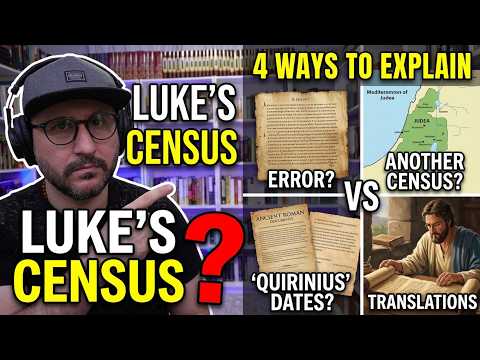
4 Scholarly Takes on Luke's Census Problem (Holland, Ehrman, Wright, Goodacre)
Mark Goodacre
24.41
26 May 2026
8 June 2026
Luke 2:2 tells us Jesus was born during a worldwide census taken when Quirinius was governor of Syria — and that one sentence has puzzled historians for centuries. When you line it up with Roman records and Josephus, the dates, the locations, and the people involved don't quite fit. So did Luke get it wrong?
In this video we put on our historian hat — no agenda, no polemic, just the evidence — and walk through the three "anchors" Luke gives us (King Herod, a worldwide census, and the governorship of Quirinius) and why scholars argue they can't all line up at the same time.
Along the way we look at how different scholars approach the problem, from Tom Holland and Bart Ehrman on the skeptical side, to N.T. Wright's "before Quirinius" reading of the Greek, to Mark Goodacre's take, which I find the most compelling of all.
Timestamps:
00:00 The problem with Luke 2:2
02:00 Luke's three anchors: Herod, the census, and Quirinius
09:00 Tom Holland on the Roman historical record
11:00 Bart Ehrman: Josephus, the 6 CE census, and travel for taxation
16:00 N.T. Wright and the "first census / before Quirinius" reading
19:00 Did Luke know Josephus? (Acts 5:37 and Judas the Galilean)
24:00 Mark Goodacre's solution
So — do you think Luke made a historical mistake? Is there a solution we haven't cracked yet? Or was the point never about the dates at all? Drop your answer in the comments. I read them, and I genuinely love a good, respectful debate.
If this helped you see an old passage in a new way, subscribe for more — next time we dig into another question from New Testament scholarship.
📚 Course mentioned: Mark Goodacre's "Mysteries of the Synoptic Gospels" at Biblical Studies Academy (bsabartmn.com)
#BiblicalScholarship #Luke #ChristmasStory #HistoricalJesus #NewTestament