Life Worth Living by Miroslav Volf (Author), Matthew Croasmun (Author), Ryan Mcannally-linz (Author)
Miroslav Volf
6.34
14 June 2026
17 June 2026
Summary: Life Worth Living is a guide to finding your own answers to life’s biggest questions, based on a popular Yale class, drawing on a wide variety of examples, religions, philosophies, and historical individuals, so you can discover how you should live for maximum meaning and significance.
At $87,000 per year when factoring in housing, food, and learning materials, a 4-year-degree from Yale University will now set you back almost $350,000. Or, you could skip the 4% acceptance rate and insane cost, and take some of their best classes for free.
“The Science of Well-Being,” for example, a course about happiness — and with over 4.5 million enrolled students, Yale’s most popular one in their 300-year-history. “Life Worth Living” is a close second, and with an equally important topic: What does it mean to live a good life?
Drawing from many different traditions, religions, and philosophies, professors Miroslav Volf, Matthew Croasmun, and Ryan McAnally-Linz equip students with the intellectual tools they need to reflect on and answer life’s big questions for themselves. Now a New York Times bestselling book, Life Worth Living: A Guide to What Matters Most brings those tools right to you and me!
Here are 3 lessons that will help you define and live a good life:
If we want to find true meaning, we must venture to the deepest of 4 levels of life.
The big “Question” about life’s meaning breaks down into 6 smaller but still significant questions.
There are 3 exercises we can use to keep asking “the Question” on a regular basis.
Let’s discover what makes life worth living!
Lesson 1: We interact with life in 4 different layers, and finding true meaning requires us to go to the deepest one.
At a friend’s birthday party when I was 10, I was too scared to jump off the 10-meter tower in the public pool. I did, however, graduate from the 1-meter to the 3-meter diving board! Engaging with life’s big questions works in a similar way, the authors suggest. You can’t jump right from the 10-meter tower!
“What matters most? What is a good life? Which kind of life is worthy of our humanity? What [even] is true life?” These questions can make your head spin.
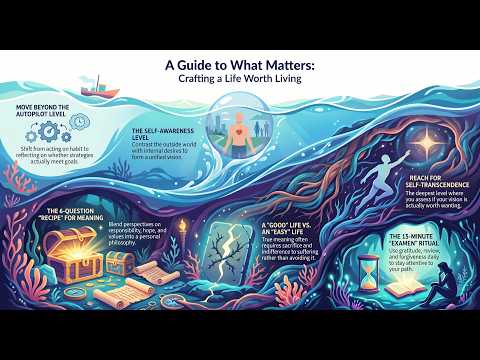
Equating the journey of discovering meaning to a deep-sea dive, the authors suggest a 4-layer model of life:
The autopilot level is where we take action according to our habits. “We do what we do because that’s what we do,” we might say.
At the effectiveness level, we reflect on our strategies when our habits aren’t helping us reach our goals. “Is what we do getting us what we want?” we might ask.
The self-awareness level is where we contrast the outside world with what we truly want on the inside and form a vision of how to unite the two. “What do we really want?” is the question.
At the self-transcendence level, we assess the validity of our vision in hopes of finding truth. We muse about the question, “What is worth wanting?”
The first level happens on the plane of taking action. The other 3 are forms of reflection. To not lose our wits, we must slowly descend through the stages, then come back up with our findings, the authors suggest. So stay aware of which of the 4 stages you’re in at any given time, and gather your findings as you go along.
Lesson 2: The big “Question” of life breaks down into 6 sub-questions, each of which offers plenty of food for thought.
Having arrived at the bottom of the meaning-ocean of life, we encounter what the authors call “the Question.” It’s an umbrella term for all inquiries related to purpose. In the book, however, they offer 6 main components, each a big question in its own right:
What’s worth wanting? This is about not just satisfying our own desires but making sure our vision aligns with our values, truth, and what’s right.
Where are we starting from? Is what the authors call “the Walgreens vision of happiness” — living a long, healthy, happy life — really the end-all, be-all? Or might other things be more important?
Who do we answer to? What are our responsibilities? Who else are we responsible for, and how big is that circle? Is there a higher power we’ll have to answer to?
How does a good life feel? While in prison, Oscar Wilde discovered that some pleasures, like freedom and simplicity, are worth more sacrifice than others, like sex and drinking. The Buddha teaches us to become indifferent to suffering rather than try to eliminate it. A “good” life does not mean an “easy” life.
What should we hope for? How much attachment is okay? For whom? Should our vision of the good life apply to everyone?
How should we live? This one sums up all the other questions. We’ll never have perfect certainty, but if we “begin with the end in mind,” as Stephen Covey suggested, we can answer them well and continue to evolve.
Answering “the Question” is like crafting a recipe. You’ll have to pick whatever ingredients you need from various philosophies, people, and your own reflections, then cook it all into your own, delicious meaning of life!