Charles Taylor: "Secularism and Multiculturalism" – Launch of the Institute for Social Justice
Charles Taylor
47.58
23 February 2017
4 April 2026
Multiculturalist policies are attempts to fulfil a requirement of modern democracies, particularly in the West: they aim to be inclusive. Yet these democracies are periodically tempted to target minorities, and brand then as second-class citizens. The temptation to do this flows from one of the core requirements of democracy, a strong common political identity. Recently many “Western” democracies (this is not simply a geographic category) have slipped into this negative stance towards religious minorities, in particular Muslims. French (and Quebec) policies of “laïcité” (secularism) provide examples. What drives these? Why the focus on religion? Are the policies which flow from this negative stance counter-productive, even dangerous? These are the questions which this talk addresses.
Professor Charles Taylor is one of the most important thinkers of the last half-century and is the recipient of the Templeton Prize, the Kyoto Prize, the John W. Kluge Prize (the Nobel Prize for scholars in the humanities and the social sciences), and the first ever Berggruen prize. A philosopher and public intellectual of enormous range and depth, Taylor has achieved a very large and diverse readership through the huge impact of such books as Sources of the Self (1989), Multiculturalism and the Politics of Recognition (1994), and his magnum opus, A Secular Age (2007), hailed by the New York Times as “a work of stupendous breath and erudition.”
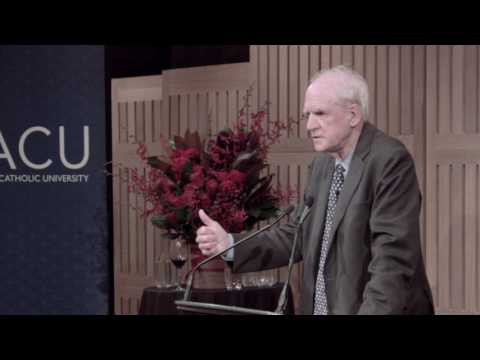
Professor Charles Taylor's remarks on secularism and multiculturalism were delivered at the launch of the Institute for Social Justice, a research institute of the Australian Catholic University, in the Utzon Room at the Sydney Opera House, on 28 April 2016.